
Category: Hanga | Create
Response to text
Response to text
Health and Well-being
Use the bold (control + b) function to highlight the correct answer.
- Which of the following is NOT a component of health according to the World Health Organisation (WHO)?
a) Physical health
b) Mental health
c) Emotional health
d) Social health
- What factors can affect physical health?
a) Genetic factors
b) Social factors
c) Economical factors
d) All of the above
- Which of the following is NOT a key aspect of physical health?
a) Regular exercise
b) Proper diet and nutrition
c) Emotional well-being
d) Proper rest for physical recovery
- What does mental health refer to?
a) Physical well-being
b) Emotional and psychological well-being
c) Social interactions and relationships
d) Financial stability and success
- How can good family and friends impact mental health?
a) By improving physical fitness
b) By promoting healthy eating habits
c) By providing emotional support
d) By enhancing social skills
- Social health is related to which aspects of life?
a) Family, work, school, and friends
b) Physical fitness and nutrition
c) Emotional well-being and stress management
d) Sleep and personal hygiene
- What is the definition of well-being?
a) Feeling happy all the time
b) Being physically fit and healthy
c) A state of complete physical, mental, and social well-being
d) Managing stress and having high life satisfaction
- What is the primary focus of emotional well-being?
a) Managing external difficulties and challenges
b) Maintaining a healthy body through exercise
c) Identifying and managing emotions
d) Achieving life satisfaction and purpose
- Which of the following is NOT included in physical well-being?
a) Sleep
b) Personal hygiene
c) Healthy eating
d) Managing stress
- How does emotional well-being differ from physical well-being?
a) Emotional well-being is about internal management, while physical well-being is about external care.
b) Emotional well-being focuses on exercise, while physical well-being focuses on emotional expression.
c) Emotional well-being is solely related to mental health, while physical well-being is related to physical fitness.
d) Emotional well-being and physical well-being are synonymous terms.
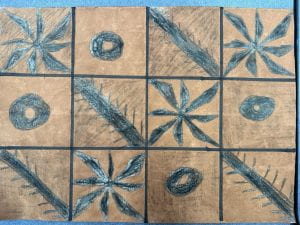
Samaon Siapo
Task description: We have been learning all about patterns in maths and we created a piece of artwork showing a repeating pattern. We did this learning on Samoan Language week so we created our very own Samoan siapo. Please check out my beautiful artwork below.
Volcanoes – Response to Text
Volcanoes: Response to text
Bold the correct answer (highlight then ctrl + b)
- What is a volcano?
a) A place where hot, melted rock (magma) and gases from inside the Earth erupt onto the surface.
b) A place where hot, melted rock (magma) and gases from inside the Earth are stored.
(c) A place where hot, melted rock (magma) and gases from inside the Earth are cooled and solidified.
- How do volcanoes form?
(a) Where the Earth’s tectonic plates are moving apart.
(b) Where the Earth’s tectonic plates are moving together.
(c) Where the Earth’s tectonic plates are moving in different directions.
- What are the different types of volcanoes?
(a) Composite, shield, and cinder cones.
(b) Composite, shield, and stratovolcanoes.
(c) Cinder cones, shield, and stratovolcanoes.
- What are the dangers of volcanoes?
(a) They can erupt and cause a lot of damage.
(b) They can be very beautiful.
(c) They can provide a lot of resources.
- What are some of the benefits of volcanoes?
(a) They can create new land, provide minerals, and help to fertilise the soil.
(b) They can be very dangerous.
(c) They can be very beautiful.
Number of the Week
Task description: This week my number is 189
Patterns Week 6
Task description: This week for maths we have been learning all about repeating patterns. It is also Samoan language week so we have been learning about different Samoan designs used for siapo. For our task we had to find out the core pattern for some repeating patterns and then research some Samoan designs that we would use in our Samoan siapo. Please check out my learning below.
Response to text
Emotions
Response to text
Bold the correct answer (highlight then ctrl + b)
- What are emotions?
a) Physical sensations we experience in different situations.
b) Thoughts and beliefs about ourselves and others.
c) The feelings we experience in different situations.
d) Actions and behaviors we display in response to stimuli.
- Which of the following is NOT a common emotion mentioned in the text?
a) Happiness
b) Surprise
c) Confusion
d) Anger
- How do we express our emotions?
a) Through written words and letters.
b) By sharing our thoughts and beliefs.
c) Through facial expressions, body language, and voice tone.
d) By engaging in physical activities.
- How can we understand others’ emotions?
a) By ignoring their feelings and focusing on ourselves.
b) Through empathy, paying attention, and communication.
c) By telling them how they should feel.
d) By dismissing their emotions as unimportant.
- What is a strategy mentioned in the text for managing emotions?
a) Ignoring and suppressing emotions.
b) Avoiding situations that trigger emotions.
c) Taking deep breaths and engaging in positive distractions.
d) Blaming others for causing our emotions.
- Why is it important to respect and acknowledge everyone’s emotions?
a) It helps us manipulate and control others.
b) Each person’s feelings are valid and deserve to be heard.
c) It prevents us from experiencing our own emotions.
d) It allows us to disregard the impact of our actions on others.
- How can understanding and managing our emotions benefit us?
a) It helps us suppress our emotions completely.
b) It allows us to avoid experiencing any negative emotions.
c) It helps us develop strong relationships and navigate different situations.
d) It makes us immune to the influence of others’ emotions.
- What is the overall message about emotions in the text?
a) Emotions are unnecessary and should be ignored.
b) Emotions are only important for certain people.
c) Emotions are a natural part of life and should be understood and managed.
d) Emotions are unpredictable and cannot be controlled.
Kayla’s earth task
task description:Today room 10 is doing there maths